12 May 2025
Application of laser processing technology in the manufacture of engineering machinery
As the modern manufacturing industry rapidly becomes more intelligent, automated and digitalised, laser processing technology, which is characterised by high precision, efficiency and flexibility, is being widely adopted in engineering machinery manufacturing. This study explores the application and development potential of laser processing technology in this field, analysing its advantages in key processes such as cutting, welding, surface treatment and precision machining. It also highlights the important role of laser processing technology in improving product quality and production efficiency, providing a technical basis and practical guidance for technological innovation and industrial upgrading in the engineering machinery manufacturing industry. This study also highlights the importance of product quality, production efficiency, technical innovation and industrial upgrading for the construction machinery manufacturing industry.
1. Principle and characteristics of laser processing technology
1.1 The basic principle of laser processing technology
Laser processing technology uses high-power-density laser beams to process materials. The principle is that the interaction between the laser and the material achieves melting, vaporisation or a heat-affected zone change to process the material. Laser processing technology is non-contact, high-precision, high-speed and flexible, and can process complex shapes while reducing the thermal impact and deformation of materials in the field of engineering machinery manufacturing. In this field, laser processing technology can significantly improve processing accuracy and efficiency and reduce production costs. It is an indispensable high-precision technology in modern manufacturing.
1.2 The main types of laser processing technology
Common applications of laser processing technology include laser cutting, laser welding, laser marking, laser engraving, laser surface hardening and laser cladding. Laser cutting technology is important in sheet metal processing due to its high cutting speed and excellent cutting quality. Laser welding is widely used in precision welding due to its advantages of deep melting width, a small heat-affected zone and minimal deformation. Laser marking and engraving technology plays an important role in product identification and artistic creation thanks to its high precision and durability. Laser marking and engraving technology plays an important role in product identification and artistic creation thanks to its high precision and durability. Laser surface hardening and cladding technology change the surface properties of materials to enhance the workpiece's wear and corrosion resistance. These technologies complement each other and promote the wide application and development of laser processing technology in engineering machinery manufacturing.
1.3 Advantages and limitations of laser processing technology
Laser processing technology has many advantages in the modern manufacturing industry, including high processing precision, high speed, a small heat-affected area, automation and intelligent control. It occupies an important position in the industry and can realise fine operations on materials, reducing waste and improving production efficiency. Its non-contact characteristics reduce mechanical stress on workpieces and make it suitable for brittle materials and high-precision processing. However, the technology has some limitations, such as the high cost of equipment and specific requirements for the operating environment.
2. Laser processing technology for engineering machinery manufacturing applications
2.1 Application direction one: cutting technology
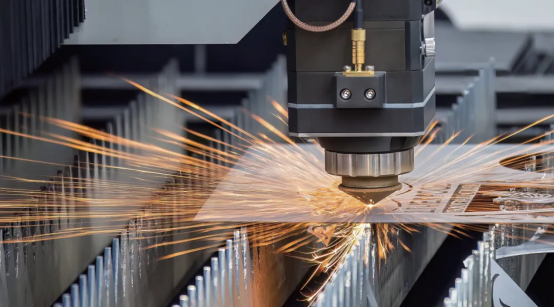
Laser cutting technology plays a vital role in the manufacturing of engineering machinery. The technology uses a high-energy-density laser beam for non-contact cutting of materials, achieving high-precision, high-speed processing. Compared with traditional mechanical cutting methods, it has several advantages, including a smaller heat-affected zone, less processing deformation, broader material adaptability and a more flexible processing path design. Laser cutting technology is widely used in processing thick plates and shaped parts. Engineering machinery usually requires structural parts with high strength and stiffness. Laser cutting can accurately cut according to design drawings to ensure the geometric dimensions and precision requirements of the parts, thereby improving the performance and reliability of the entire machine. It can also achieve complex shapes in one moulding process, simplifying the processing procedure and shortening the production cycle while reducing manufacturing costs. However, it is not easy to apply laser cutting technology in practice. Laser cutting technology also faces challenges when applied to high-reflectivity materials such as copper and aluminium. The efficiency and quality of laser cutting may be affected, and laser cutting equipment and operating costs are relatively high. The technical level of the operator is also required to be high.
2.2 Application direction two: welding technology
Laser welding technology is an advanced connection process that uses a focused laser beam to generate high temperatures, melting and solidifying the material to form a weld. This process has notable features such as deep melting width, a small heat-affected zone, high welding speed and minimal deformation, improving the strength of the connection of structural parts of construction machinery and playing a key role in enhancing the overall performance. Laser welding technology is widely used to connect high-strength steels, aluminium alloys and other materials. Construction machinery operates in complex and variable environments, so there are very high requirements for the strength and durability of structural components. Laser welding technology can provide high-quality welds and enhance the mechanical properties of the welded joints to meet the reliability demands of construction machinery operating in harsh conditions.
2.3 Application direction three: surface treatment technology
Laser surface treatment technology is a key technology in the field of engineering machinery manufacturing. By irradiating a laser beam onto the surface of a material, it is possible to improve its surface properties, including laser hardening, laser cladding, laser alloying and so on. This process does not affect the performance of the material matrix, while significantly improving the wear resistance, corrosion resistance and fatigue strength of the material surface. In the construction machinery sector, components are often subjected to severe working conditions and must meet stringent durability and reliability requirements. Laser surface treatment technology can effectively extend the service life of mechanical components and reduce maintenance costs. Laser cladding technology involves adding a layer of material with specific properties to the surface of mechanical components, providing additional wear-, corrosion- and high-temperature resistance.
2.4 Application direction four: precision micromachining technology
In the precise processing of critical construction machinery components, the versatility of materials is a significant advantage of laser micromachining technology. For materials such as metals, ceramics and plastics, laser micromachining can provide highly efficient solutions, offering stronger technical support for the realisation of diverse designs and functional integration in construction machinery. However, it should be noted that the precise control of laser parameters in the micro-machining process is very demanding; even the slightest deviation may lead to a decline in processing accuracy. To realise the full potential of laser micromachining technology in manufacturing precision parts, researchers must continuously improve laser equipment processes, update and optimise laser control systems, reduce equipment costs through interdisciplinary collaboration, strengthen equipment operator training, and enhance understanding of laser micromachining technology and its applications.
3. Laser processing technology in the development of engineering machinery manufacturing: trends and challenges
With the rise of intelligent manufacturing and the demand for sustainable development, laser processing technology is becoming increasingly prevalent in the construction machinery manufacturing industry. The development of laser processing technology will focus on high efficiency, precision and intelligence. The research and development of high-power lasers will significantly improve the cutting and welding speed and quality. Progress in laser micromachining technology will also meet the demand for high-precision parts. With the integration of computer-aided design and artificial intelligence algorithms, the laser processing process will become more automated and intelligent.