12 May 2025
Quality factors in laser cutting
The quality of the laser cutting process is determined by the dimensional accuracy of the cut and the quality of the cutting surface. The quality of the cutting surface is generally measured by the following four indicators: the width of the kerf and the roughness of the kerf surface; the width of the heat-affected zone; the ripple in the kerf section; and whether or not there is slag hanging from the lower surface of the kerf section. The main factors affecting the surface quality of laser cutting are as follows:
1. The laser beam quality
Laser cutting is based on the thermal effect of processing. In order to achieve a fine kerf and high power density, the focused spot diameter should be small. At the same time, to ensure consistent cutting quality in different directions, the laser beam should have good rotational symmetry around the optical axis, circular polarisation, and a stable and consistent launching direction. Modern lasers should also have a continuous and high repetitive output and fast switching function to ensure high-quality cutting of complex contours.
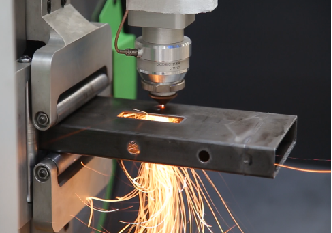
2. Focusing lens and plate thickness:
the focal length of the lens should be chosen according to the thickness of the material to be cut, taking into account the focus spot diameter and depth of focus. The thicker the material, the larger the focal length should be, and vice versa. The focus spot should be located close to the surface of the workpiece; generally, the focus should fall on the upper surface of the plate, approximately 1/3 of the plate's thickness down.
3. Gas flow and nozzle:
In laser cutting machines, gas flow blows off the molten material to protect the focusing lens and provide some cutting energy. Gas pressure and flow are important factors affecting cutting quality: if the pressure is too low, the molten material will not be blown away at the kerf; if it is too high, eddy currents will easily form on the surface.
4. Outsourcing laser cutting processing:
the cutting speed depends on the power density of the laser, the thermal and physical properties of the material being cut, and its thickness. For certain cutting conditions, there is a reasonable range of cutting speeds. If the cutting speed is too high, the kerf slagging is not exhaustive and the material may not be cut through. If the cutting speed is too low, the material may burn and the kerf width and heat-affected zone may increase.
5. Cutting trajectory:
for complex contours or parts with inflection points, changes in acceleration can easily cause overheating, melting and the formation of collapse angles at the inflection point. Thus, a reasonable cutting trajectory is one of the most effective ways to avoid this phenomenon.